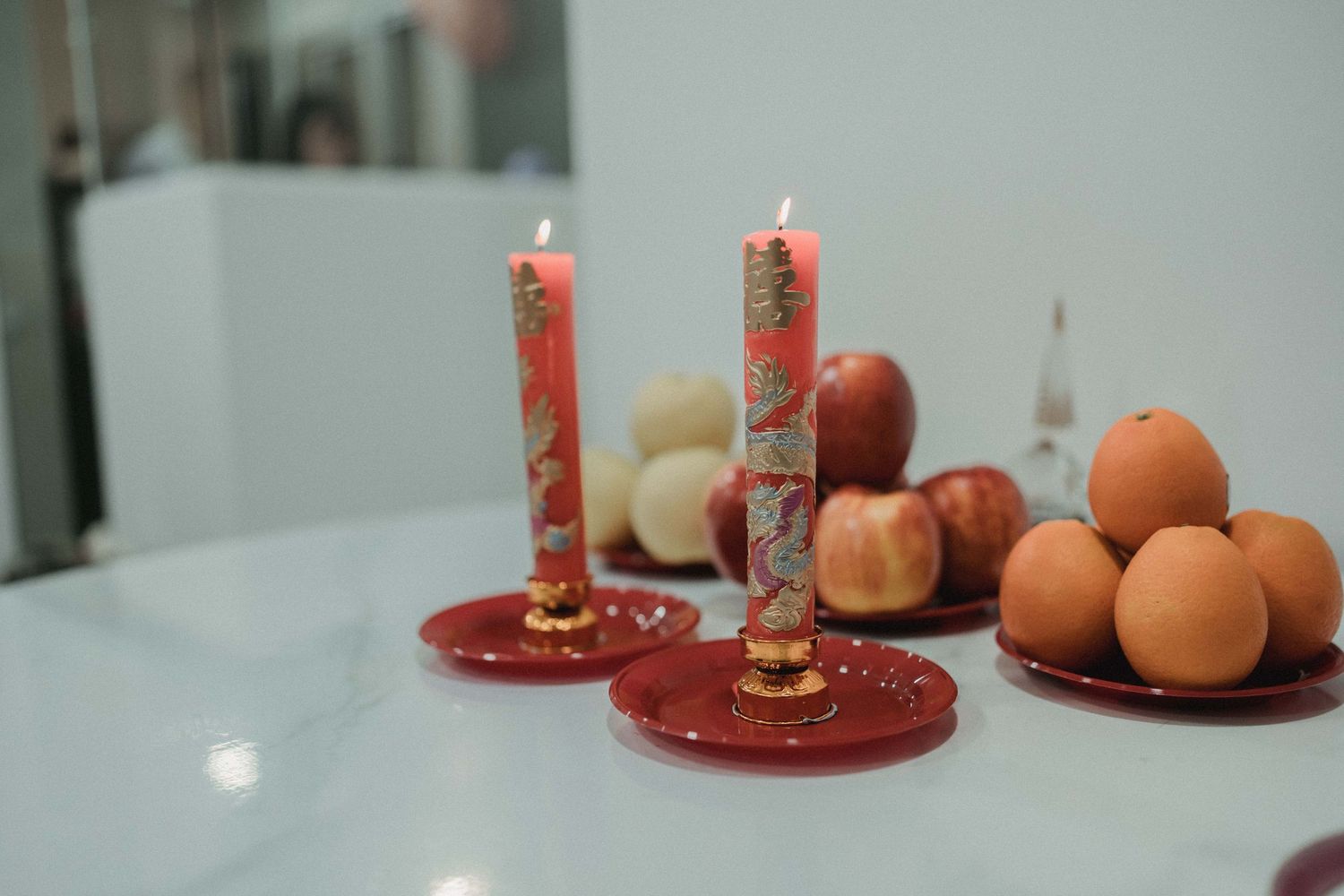
Before the gatecrash, the tea ceremony, and the banquet, many Chinese Singaporean couples mark one quieter milestone: Guo Da Li (过大礼), the betrothal ceremony. It's usually small, held at the bride's family home, and over within a couple of hours. It's also the moment the two families formally come together, and traditionally, the point at which the couple is considered engaged.
This guide explains what happens at a Guo Da Li, what's usually exchanged, how families differ, and which moments are worth photographing. Planning yours? Message us on WhatsApp and we'll help you plan the photos around it.
What is Guo Da Li?
Guo Da Li translates loosely as "passing the big gifts". The groom's side visits the bride's family home and presents betrothal gifts to thank her parents for raising her, and to show the groom's family's sincerity. The bride's family accepts the gifts and returns a portion of them, signalling that they accept the proposal.
It's one of the traditional Chinese wedding customs that remains widely practised in Singapore, though many families now keep it simpler than their parents did.
When is it held?
Guo Da Li is usually held two to four weeks before the wedding, on an auspicious date. Many families consult the Chinese almanac or a fengshui master, and avoid periods such as the Hungry Ghost month and Qing Ming.
Check the date with both sets of parents early. It often has to fit around elders' schedules, and in a busy wedding month, the photographer's calendar too.
Who attends?
Traditionally, the groom visits the bride's home with a matchmaker or an elder female relative from his side. Today it's often a small group: the groom, his parents or a senior relative, and the bride's immediate family.
Practices vary by family and dialect group, so it's worth asking your elders who is expected to be there before you plan anything else.
What's in the betrothal gifts?
The exact items depend on dialect group and family tradition. Across Hokkien, Teochew, Cantonese and Hakka families, common items include:
- Pin jin (聘金) — the betrothal money, presented in a red packet
- Dragon and phoenix candles
- Traditional wedding cakes or biscuits
- Oranges — for good fortune
- Pig trotters or roast pork
- Liquor or wine
- Jewellery — in Cantonese families especially, gold jewellery for the bride is a key part of the gifts
A common rule of thumb in Singapore: perishable items follow the bride's family's dialect customs, while non-perishable items follow the groom's. When in doubt, the bride's parents' expectations usually lead.
Many couples now order a ready-made Guo Da Li set from a wedding shop, which takes care of the items and the presentation baskets. Hokkien and Teochew families each have their own traditional basket styles.
The return gifts (Hui Li)
After accepting the gifts, the bride's family returns a portion of them. This is called Hui Li (回礼). It's a gesture of goodwill: they accept the proposal and entrust their daughter to the groom's family.
The bride's dowry (jia zhuang, 嫁妆) is often presented at the same time. These are practical and symbolic items for her new household, and the selection varies by family.
What to photograph at a Guo Da Li
The ceremony is short, so most of the photos happen in a few concentrated moments:
- The gifts laid out before the exchange. Baskets, candles, red packets and jewellery arranged together are a beautiful still life, and the one shot almost every family wants framed.
- The arrival. The groom's side carrying the gifts in, and the first greeting at the door.
- The presentation. Gifts being handed over and the bride's parents receiving them.
- Parents' reactions. The quiet looks between parents are usually the most meaningful frames of the day.
- The return gifts and dowry. Items being selected and handed back.
- Details. Close-ups of the pin jin envelope, the jewellery, and the candles.
- Family portraits. Both families together, while everyone is dressed and in one place. For many families, this is the first portrait of them together.
Getting good photos at home
Most Guo Da Li ceremonies happen in an HDB flat or condo living room, and a little preparation makes a visible difference:
- Clear the background. Move shoe racks, laundry and clutter out of the main area where the gifts will be presented.
- Use window light. Set up the gifts near a window if you can. Soft daylight is far more flattering than overhead fluorescent lights.
- Leave space to move. The photographer needs a little room around the gift table and the family.
- Hold the start time. A late start shortens the time left for family portraits.
Should you hire a photographer for Guo Da Li?
It depends on how much the ceremony matters to your family. Many couples rely on a relative's phone, and that can be enough for a quick record. But Guo Da Li is often the only time both families gather formally before the wedding, and grandparents in particular may value good photos of it more than you expect.
If you'd like it photographed, mention it when you plan your wedding coverage, so the two can be planned together. The main event, from the gatecrash and tea ceremony to the banquet, is covered by our actual day wedding photography in Singapore, with packages from $1,548 (6 hours) to $2,488 (10 hours).
How Guo Da Li fits into your wedding timeline
A typical Chinese Singaporean wedding sequence runs roughly like this:
- Guo Da Li — two to four weeks before the wedding
- Bed setting (An Chuang) — in some families, a few days before the wedding
- The wedding day — preparations, gatecrash, tea ceremony, and the banquet
For how the wedding day itself flows, see our Singapore wedding day timeline. For the moments to capture across the whole day, our wedding day shot list covers the rest.
Frequently asked questions
- What is Guo Da Li? => Guo Da Li (过大礼) is the traditional Chinese betrothal ceremony. The groom's side presents gifts to the bride's family, who accept them and return a portion as a sign of acceptance.
- When should Guo Da Li be held? => Usually two to four weeks before the wedding, on an auspicious date chosen with the families, avoiding periods such as the Hungry Ghost month and Qing Ming.
- What items are needed for Guo Da Li? => Common items include the pin jin red packet, dragon and phoenix candles, wedding cakes, oranges, pig trotters or roast pork, liquor, and jewellery. Exact items vary by dialect group.
- What is Hui Li? => Hui Li (回礼) is the return of part of the gifts by the bride's family, showing that they accept the proposal. The bride's dowry is often presented at the same time.
- Does the groom attend Guo Da Li? => Traditionally, the groom attends with a matchmaker or an elder female relative. Many families today keep it to the couple, their parents, and close relatives.
- Is Guo Da Li worth photographing? => For many families, yes. It's often the only formal gathering of both families before the wedding, and the gift layout and family portraits become lasting keepsakes.
Planning your wedding photography?
Tell us your Guo Da Li and wedding dates, and we'll help you plan the photos around both. Message us on WhatsApp